Predictable GPUs for Safety-critical Systems
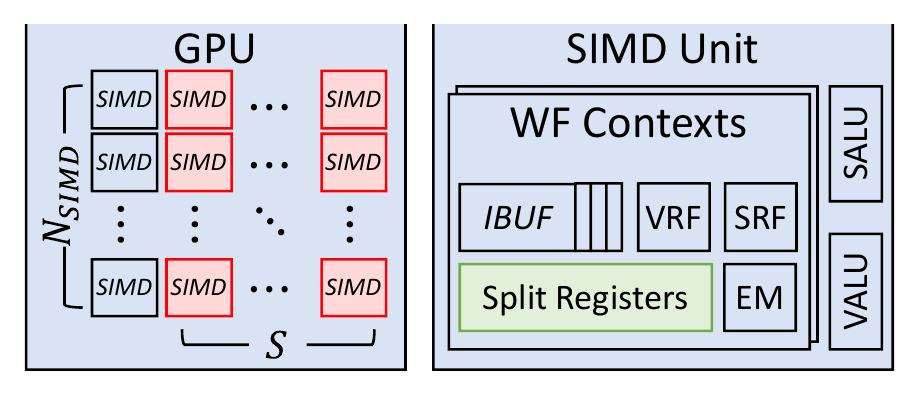
GPUs offer large speedups for massively parallel workloads such as the perception tasks in autonomous driving. Using them in safety-critical systems requires worst-case execution time (WCET) estimates, and branch divergence, where threads in a wavefront take different paths and execute serially, makes those estimates large.
This project develops predictable wavefront splitting (PWS), which splits diverging wavefronts into separately schedulable entities while keeping the WCET analyzable.
- Architecture. PWS adds micro-architectural enhancements to an AMD-based GPU and a compiler pass that removes branch serialization, improving performance while lowering the WCET compared with prior wavefront-splitting work.
- Compiler. A compiler phase selects, with an optimal algorithm, the branches at which to split wavefronts so that the kernel’s WCET is as low as possible. It is evaluated on a gem5 model of the AMD GCN3 GPU, where it reduces the WCET by 34% to 52% compared with five alternative approaches.
The 2025 ACM TECS article studies optimal split-point placement for predictable wavefront splitting.